

If you regularly care for your nails, you’ve likely encountered nail drills and a wide array of bits they come with. Some are pointy and made of metal, while others feature cylindrical rods with abrasive elements built-in.
In this nail drill bits guide, I’ll discuss everything you need to know about nail bits as a beginner. Let’s dive right in!
What Is a Nail Bit?
Nail drill bits are coated drill tips used to file nails, clean nails, or remove nail enhancements. They’re usually attached to an electric-powered rotary tool called electric nail drill or e-file. They’re available in an array of materials depending on the delicacy of the job, such as:
- Stainless steel
- High alloy steel
- Carbide
- Tungsten carbide
- Diamond
- Ceramic
- Gold
Types of Nail Bits

There are five main types of nail bits, including:
Cone Bits
Cone bits have pointed or rounded tips. They’re used to remove gel or excess acrylics that were added under the nails during application. Likewise, they prepare the cuticle area and sidewalls.
Needle Bits
Needle bits clean under the nails and the sidewalls. They have small and pointed heads that allow them to get in tight and hard-to-reach spaces.
Silicone Bits
Made with soft plastic silicone, silicone bits are used for polishing the nail’s surface to make it smoother.
Ball Top Bits
Ball-top bits feature a ball-shaped head that is used for cleaning Eponychium (medial or proximal nail fold), removing loose cuticles, and softening hard skin around the nail.
Barrel Bits
Barrel bits are mostly used for surface work, i.e., shortening, backfill cutting, shaping, etc.
How to Choose the Right Drill for Your Nails
When choosing a nail drill, consider the following factors:
- Rotational Speed: For natural nails, search for a drill that goes up to 15,000 RPM. For acrylic nails, search for a drill that goes up to 25,000 RPM at least.
- Weight: Whenever possible, opt for a light nail drill so your hands and wrists won’t hurt after a long day’s work.
- Rechargeable: For your convenience, search for a rechargeable nail drill with long battery life.
- Low vibration, low noise, and low heat: High-quality nail drills don’t produce much noise, heat, or vibration. These factors affect not only the accuracy of your work, but also the drill’s overall longevity.
How to Practice Using Nail Drills
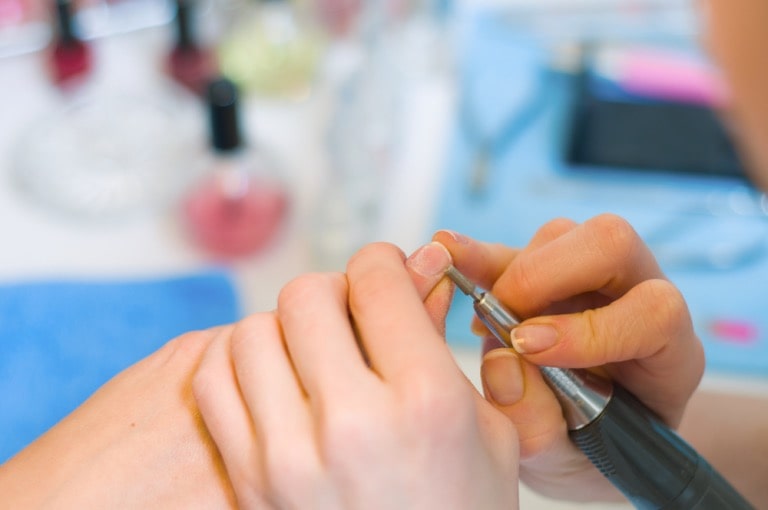
The best way to practice using nail drills is through personal use.
Hold the nail drill with your dominant hand and move the drill from one side of your nail to the other. Keep the nail drill close to your nail and move the device in small, circular motions.
Regulate the speed anywhere between 2,500 and 6,000 RPM, only increasing when you feel confident with your skills.
Once you’ve perfected using the nail drill on your own nail, practice the nail drill on a trusted friend’s finger.
How to Sterilize and Store Nail Bits
Here’s how to sterilize and store your nail bit after use:
- Brush off any residual dust or dirt with a stiff brush
- Clean the head with alcohol
- Soak the bit for 1 to 2 minutes in acetone
- Place the bit on a paper towel and air-dry for 5 minutes
- Store in a cool, dry place, preferably in a specialized container.
FAQs
How long do nail bits last?
Nail bits last anywhere between two to four months. If the bit isn’t cleaning and/or refining your nails in a timely manner, it’s time to replace it.
Are diamond bits made of real diamonds?
Diamond drill bits are made from real diamond powder, which is pressed into steel using high pressure.
Conclusion
There you have it, folks; your starter guide on nail drill bits!
Nail drill bits are fantastic tools for cleaning, shaping, and enhancing the overall appearance of your nails.
Remember: clean your nail bits after every use, especially if you’re using them in a professional setting. This prevents the transfer of disease from one person to another.
